
Coating Adhesion Test Methods and Instrument Selection
Introduction
Coating adhesion is a core indicator to measure the bonding strength between coatings, inks, functional films and substrates. It directly determines whether the product will suffer peeling, flaking or cracking in service. It is widely used in packaging inks, industrial paints, powder coatings, PCB protective coatings, metal and plastic coatings. Corresponding test methods should be selected for different application scenarios to obtain stable test data complying with national and international standards.
1. Main Coating Adhesion Test Methods
1. Cross-Cut Test (Grid Cut Method, GB/T 9286, ISO 2409, ASTM D3359)
Principle: A multi-blade cutter cuts a grid pattern penetrating the coating down to the substrate. Standard pressure-sensitive tape is applied and rapidly peeled off. The coating detachment within the grid area is visually rated from 0 to 5. It is a qualitative / semi-quantitative rapid test.
✅ Application: Thin coatings (film thickness ≤250 μm), conventional paints, water-based coatings, packaging inks, home appliance shells and plastic painted parts. Suitable for incoming sampling inspection on production lines and quick finished product screening.
⚠️ Limitations: Only grade judgment available, cannot output MPa strength value. Not recommended for thick coatings or high-hardness coatings.
2. Pull-Off Test (GB/T 5210, ISO 4624, ASTM D4541)
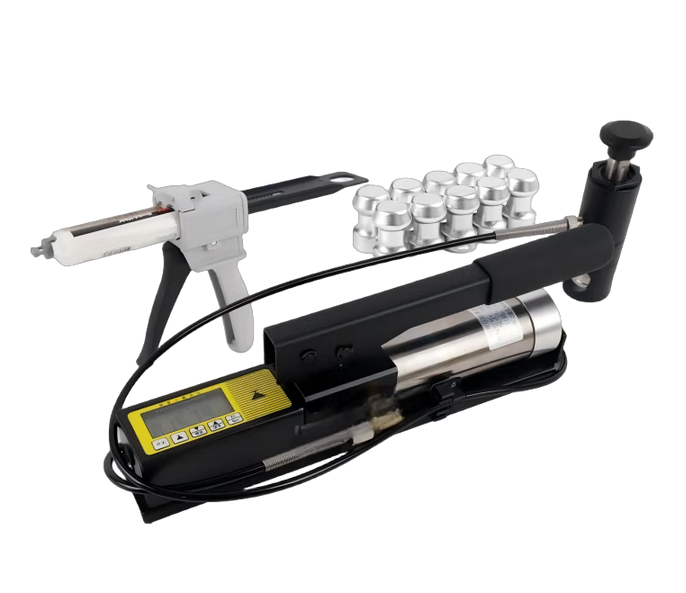
Principle: A metal dolly is glued onto the coating surface with high-strength two-part adhesive. After adhesive curing, the pull-off tester applies vertical uniform tension. The maximum force when the coating delaminates is recorded and converted into adhesion strength in MPa. This is a quantitative test.
✅ Application: Thick-film anti-corrosion coatings, high-end functional coatings, PCB photosensitive coatings, automotive topcoats and engineering anti-corrosion projects. Suitable for formula verification in R&D, quality dispute arbitration and third-party testing. It can distinguish failure modes: interface adhesion failure, cohesive failure within coating or adhesive failure.
⚠️ Limitations: Longer testing time, destructive test, waiting time required for adhesive curing.
3. Cross-Hatch / X-Cut Test
Principle: An X-shaped cut is made through the coating to the substrate. Tape is applied and peeled to visually assess paint flaking.
✅ Application: Large workpieces, curved components and on-site coating acceptance, widely adopted in automotive parts industry.
4. Scratch Test
Principle: A diamond indenter moves across the coating surface with gradually increased load. The critical load at coating delamination is recorded.
✅ Application: Hard thin films, vacuum deposition coatings, ceramic coatings and other superhard functional coatings.
2. Instrument Selection Guide
2.1 Cross-Cut Test Kit (Nitoplab NT 412 serials Cross Hatch Tester)
Components: multi-edge cutting blades (1mm / 2mm /3mm optional), brush, standard tape, magnifier. Selection tips:
- Film thickness <60 μm → 1mm blade
- 60~120 μm →2mm blade
- 120~250 μm →3mm blade For export products, use tapes compliant with ISO/ASTM standards. Advantages: Low cost, portable and fast test speed, preferred for factory daily QC.
2.2 Pull-off Adhesion Tester(Nitoplab NT 500 serials Digital Pull off Adhension Tester)
Two types: Manual hydraulic type and Automatic hydraulic type
- Manual hydraulic pull-off tester: Cost-effective, for on-site inspection and general R&D; tension applied manually.
- Automatic pull-off tester: Constant pull speed, automatic data logging with better repeatability. Ideal for CNAS laboratories and high-end product R&D. Accessories: 20mm/50mm dollies, special two-component adhesive, cutting ring. Selection tips: Match instrument range according to estimated adhesion strength; self-positioning dollies for curved workpieces.
2.3 Scratch Adhesion Tester
For hard coatings. It can set gradient loads and automatically identify critical failure points, commonly used for optical coatings and PVD coatings.
3. Selection Recommendations
- Daily production line inspection, thin ink/paint coating → Cross-cut test + cross-cut kit
- R&D formula development, thick coatings, MPa strength required, third-party testing for foreign trade → Pull-off adhension tester
- Hard deposited film, ceramic coating → Scratch tester
Notes: Test results are affected by substrate pretreatment, coating thickness, ambient temperature & humidity and cutting force. Sample condition shall be confirmed before testing, and operations shall strictly follow corresponding standards.
Conclusion
There is no universal solution for adhesion testing. Test methods and instruments should be reasonably selected according to coating type, film thickness, product standards and testing purposes, to objectively evaluate coating adhesion reliability and avoid later peeling & flaking risks.
Need help confirming an instrument or method?
Share the sample, standard and application. We will help with selection.
Send requirements