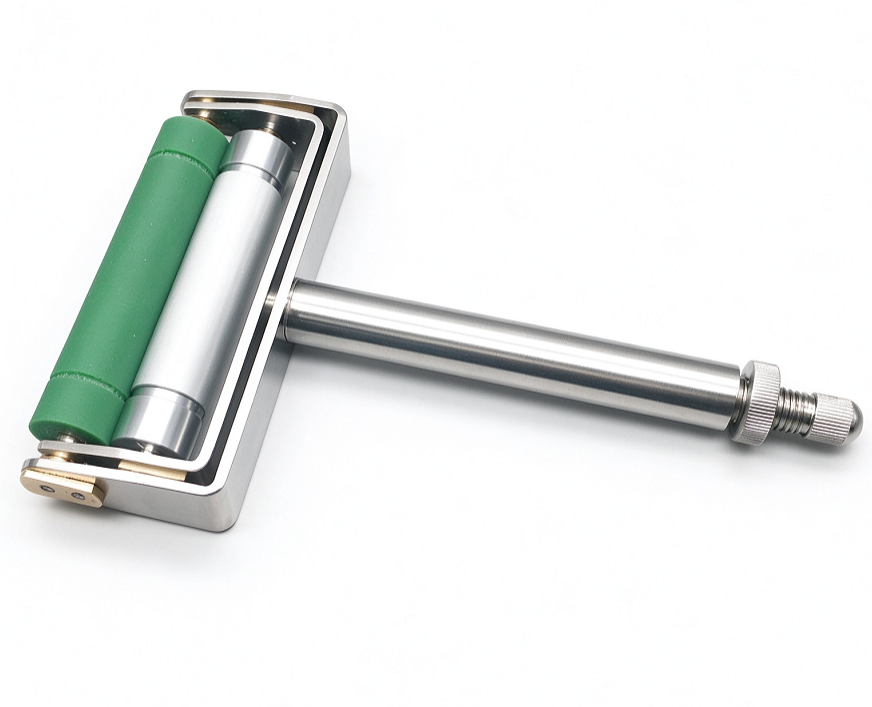
Hand proofer
This equipment applies, flexgraphic inks and other fluid coatings onto any substrate to produce repeatable proofs. It is ingeniously constructed and very easy to use. It is an essential tool for all those involved in the manufacture and use of gravure, flexographic inks and other fluid coatings.
Advantages
- Precision electroplated anilox roller with pyramid cells, stable ink loading and excellent repeatability of ink density
- Adjustable pressure between rollers; various anilox line counts available, custom line count supported
- Stainless steel frame & solvent-resistant rubber roller, anti-corrosion; rollers easy to disassemble and clean
- No power supply required, simple operation, save ink and substrate cost for R&D proofing
- Portable design with protective case, ideal for lab use and on-site incoming inspection
Application Scope
✅ Test materials: Water-based flexo inks, gravure inks, aniline inks, liquid coatings
✅ Substrates: Paper, paperboard, plastic film, aluminum foil, cellophane
✅ Application scenarios: Ink formulation R&D, spot color matching, color card making, incoming inspection for printing houses, ink import & export comparison
Test Principle :
The equipment consists of a stainless steel bracket, precision engraved metal anilox roller and solvent-resistant rubber roller. Fixed-volume cells are engraved on the surface of the anilox roller to control ink loading and ink film thickness. The pressure between the rubber roller and anilox roller is adjustable. Place a small amount of ink into the roller nip. Pull the manual proofer at a constant angle and uniform speed. The anilox roller transfers a fixed quantity of ink onto the surface of the substrate to produce a continuous, uniform color strip in one pass, for visual color comparison or spectrophotometric color measurement. Different anilox line counts (LPI) correspond to different ink loading rates, matching various printing conditions such as solid areas and halftone dots.
Technical Parameters
■ Proofing width: 70mm
■ The number of line: 100~300(Line)

Note:
1. This table is only available for Pyramid type
2. For Line Screen, divide Cell (LPI=Line Per Inch) count by 2.54 to get Lines per CM
3. For Volume, multiply BCM(billion cubic micron per square inch)by 1.55 to get cm3/m2
Video resources are being prepared. Contact our team for operation support.
Documents are being prepared. Request the latest version from our team.